

Double Double
Part 1 of my reflections on Loren Loiacono's "Do No Harm," a groundbreaking hour for two pianists that's been almost a decade in the making

News: HereNowHear, my piano duo with Ryan McCullough, recently got a generous write-up from Tyran Grillo over at Sequenza21 for our double album “sedgeflowers|MANTRA.”
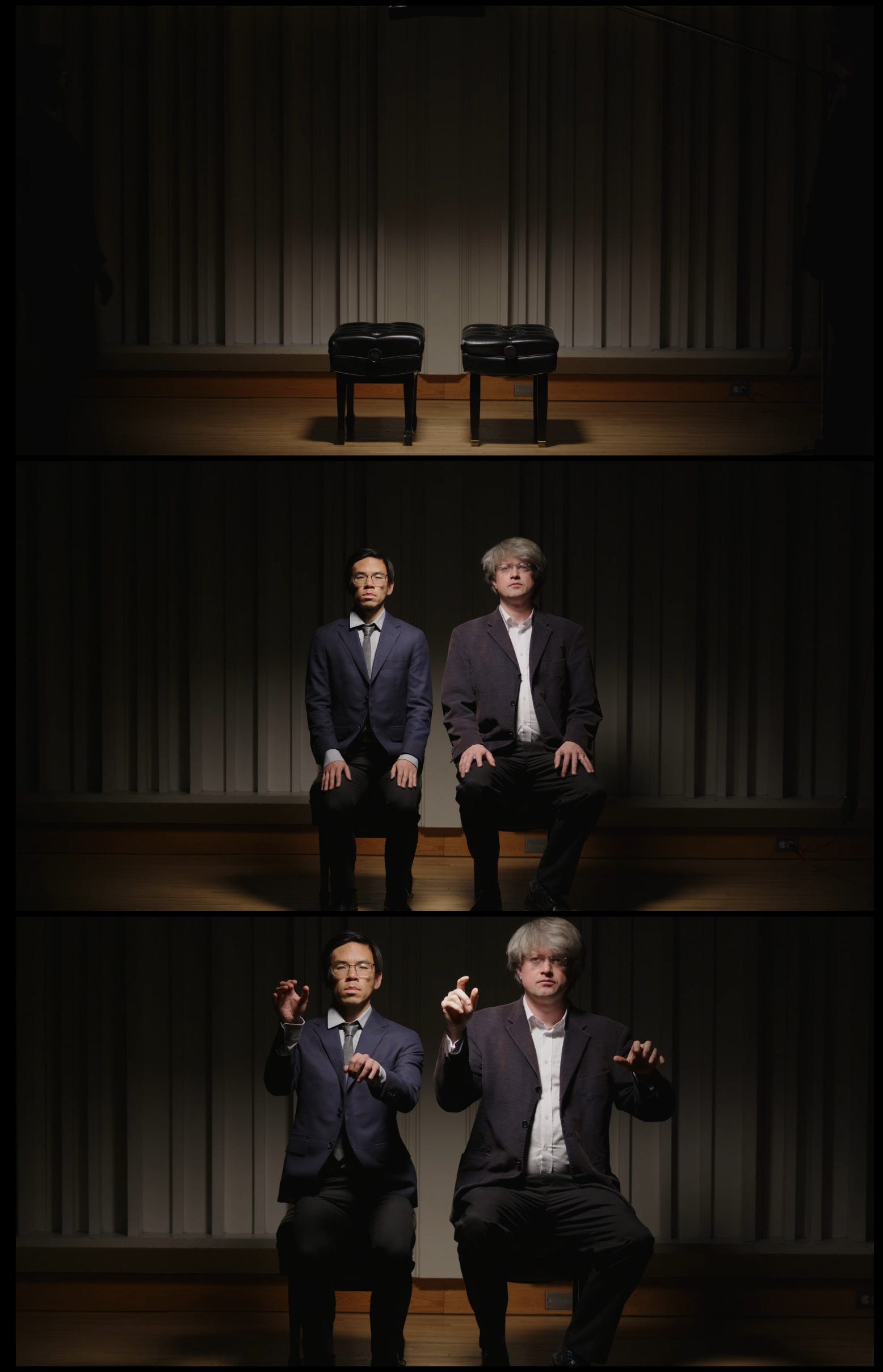
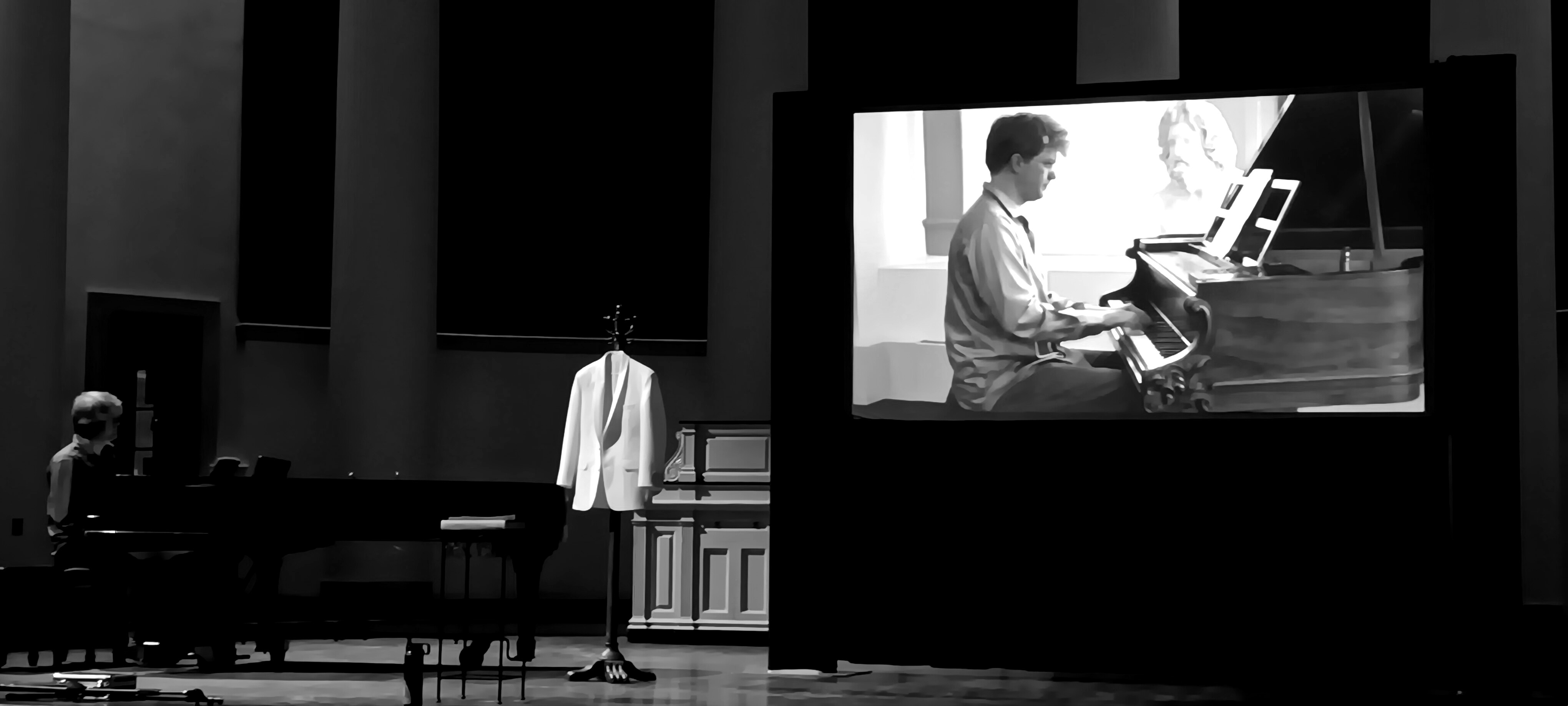
We are under a cold weather advisory here (again) in Central New York, with actual and “real-feel” temperatures dipping into the negatives. Still, last Friday night, an intimate but enthusiastic audience witnessed, with pindrop-audible attention, Ryan McCullough and I (HereNowHear) giving the premiere of Do No Harm, a seven-movement work by Loren Loiacono for piano, video projection, pre-recorded audio, and 2 pianists (and coat rack, white dinner jacket… and anatomy books). (A link for a stream of this may be found here.) It is a radical, weird, highly personal, harrowing, wacky, and uncanny work of musical theater, in that European sense of Musiktheater, one that has been in the making for almost a decade. When this work was initially premiered in a shorter version, on April 6, 2019, the US was led, somehow, by the same narcissistic president, Britain was on its way out of the EU, and Volodymyr Zelensky won the first round of the 2019 Ukrainian election. Starting last year, Loiacono composed five new movements, and we made the final push toward its revival in the earliest weeks of 2026. This last month, the US has invaded Venezuela, Minnesota continues to be under siege in a horrifying, vengeful attack on basic human rights, more Epstein files have just been released, and a winter snowstorm just brought the country to its knees. Nothing and everything has happened in the interregnum.
The work’s title, originally in its Latin incarnation Primum non nocere, comes from that cornerstone of medical ethics, the Hippocratic Oath. The well-known formulation comes from the third paragraph, which was recorded in Greece some time a couple of centuries BCE: “I will use those dietary regimens which will benefit my patients according to my greatest ability and judgment, and I will do no harm or injustice to them.” Loiacono, prefacing our performance with a set of personal remarks, reflected on the state of living with a chronic illness, in which one is never sure which self will show up on any given day. Do No Harm, with its interaction of live and video “performers,” dramatizes the various tensions between these selves.
Primum non nocere was focused on the notion of treating the piano–that big black box–like a cadaver of sorts. Ryan and I would explore it surgically: we would be in it, around it, getting in each other’s ways, negating and amplifying one another’s actions. It is both a commentary and parody of the entire history of “two pianists, one piano”, which metabolizes the traditional casual intimacy of “four-hands” duetting, famously made ripe and full of innuendo by Schubert. Nowhere is the nihilistic arithmetic of 1+1=0–the self getting in the self’s way–illustrated better than in the original first movement (now third). “Dyspnea,” the medical term for shortness of breath, involves a development on the touches bloquées technique used by György Ligeti in his piano etude of the same name, which came by way of Henning Siedentopf in a 1973 article called “Neue Wege der Klaviertechnik.” Ligeti’s keys are blocked by having one hand depress certain keys while the other plays rapid figurations around them, resulting in systematically rhythmic gaps. Loiacono takes the idea a few feet further by having me go around to the bentside of the piano (the technical term!) to stop notes within the arpeggiations that Ryan, sat normally, plays. My score has to be converted to tablature (it would need to be read with the page turned clockwise 90 degrees); high and low are flipped upside-down and stripped of orientation in the unmarked, shadowy guts of the piano.
Profile Images, or the Problems with Looking at a Piano
But the math is not simply 1+1 in Do No Harm. It is something more akin to 2x2. Newly extended are movements with video–our Doppelgangers–to which Ryan and I (live) respond. The ideal self is multiplied and put both into question and into constant conflict.
The conception for the videos was not fixed upon composition. Rather, it resulted from a series of experiments and thoughts about the piano. When I asked Loiacono about role of the doubles, she described them as “ideal” selves, more formal than our live counterparts. But why?—the audience will wonder. Ryan and I settled on recording two versions of the video, which can be played simultaneously so as to appear to be different “angles” of the same shot.
As we ideated, I realized we were confronting a bugbear I have always had with the piano. From a visual perspective, it has always been the least flexible and transparent of instruments. For starters, it’s huge: even a puny Steinway B is longer than the average height in the NBA (6’11” vs. 6’7”). It can only be oriented in one direction. You have to sit facing to the side (blame Franz Liszt). To frame any shot with the piano is to reduce the player to the left quarter of the image. The hands, the most interesting visual element, and whose visibility often determines where a listener wants to sit in the hall, ironically, remain out of sight most of the time.
Pianists, knowingly or not, have an advantage in stage anxiety management, simply because we almost never have to face the audience in the way most other instrumentalists and singers do. But every time I do anything involving movement, I either have to remain seated in position or abandon the instrument altogether.
It seemed to me that the success of the video component hinged on its articulation of the square of relations between each actor–the two live and two virtual ones. What is the role of the live performers to each other? What is the role of the virtual performers to each other? What is the role of each of us vis-a-vis our Doppelgangers?
I looked to the work of Michael Beil, whose oeuvre contains elegant ways of staging live performers and video doubles, without going into the realm of overproduction. Yet, even Beil’s solutions involving piano feel like the instrument has gotten the better of him. His work Doppel (2009), for two pianists, resolves the visual issue by redoubling the doubling. His 2017 work Key Jack (for pianist without piano with live video and tape), addresses this issue head-on, literally. Beil’s description of work reads:
In Key Jack, the grand piano has even disappeared from the stage altogether. Deprived of his beloved instrument, the pianist has exchanged his black suit for a more casual outfit. Once a sol[o]ist, he is now assisted by 2 questionable Doppelgänger. Yet, Key Jack is still a highly virtuosic solo piano piece. In front of the camera the pianist faces a mind-bending playback-challenge.
My thought, then: the piano, the specimen of experimental interest, needs to go. Beil’s Key Jack treats the missing piano à la An die ferne Geliebte, and the pianist sans piano is reduced to the average Joe (or Jane) pining for their immortal beloved, playing not on the piano but on a table. Yet, precisely the opposite happens (in my reading) of Do No Harm: the doppelgangers are more formal and can play their music without an instrument, enabling them to face the audience with an unflinching gaze of neutrality. There is an element of voyeurism here–the audience gets to see what they want to see from a pianist–their hands, and they get a full, unobstructed frontal view of it. The live versions of us, meanwhile, still have to face the traditional direction, for the simple practical reason of sound projection into the hall. With me playing primo and Ryan secundo–at least for the opening movements–Ryan is blocked from view, another visual problem the video resolves.
The opening of the work involves us live performers entering ritualistically onstage. Our doppelgangers do the same, onto a darkened stage with a single overhead spotlight that you can make out just within frame, if you pay attention. If you pay even more attention, you’ll notice that Ryan’s movements, as he settles in, are strange, jerky. Is it an issue with playback or rendering of the video? That I will leave unanswered. The game begins, our doubles at a right angle to us. The videos, our bizarre, mechanistic overlords, command us to act, but they also jitter, stutter, glitch, and break down.
Let’s make fetch happen
I recently watched two movies–the picaresque Marty Supreme–a film about a table tennis player that is not about table tennis at all, but rather about Timothée Chalamet (and the friends he knows), and the darkly comedic South Korean film No Other Choice, a parody of late-stage capitalism centering on Man-su (played by Lee Byung-hun), who decides to eliminate his leading competitors in the Korean paper industry after he is fired from an American buyout. His refusal to pivot and change career paths (his life is all paper in a film where digital devices are omnipresent) and his completely ridiculous murder plots conjured up the image of a higher-ed job candidate who, refusing to leave academia, decides instead to reduce the applicant pool by unaliving everyone in it. A more subtle subtext of No Other Choice, however, is how Man-su’s ploys force him to face off with different versions of himself. In one version, his wife is cheating on him with a younger boytoy; in another, he is deciding to leave the industry to become a shoe salesman; in another he has turned into a smug social media influencer whose real life is far more lonely than it appears.
The word “Doppelgänger” first appeared in a 1796 novel by Jean Paul (a favorite of the literarily inclined Robert Schumann) known in short as Siebenkäs. The comedy hinges on the lookalikeness between the titular Siebenkäs and his alter ego Leibgeber. Since then, spirit doubles, also known as Gothic doubles, have appeared in the works of countless authors, including Shelley, Woolf, Dostoevsky, Wilde, and Saramago. In Britain, a double is known as a “wraith;” in Irish folklore, it is known as a “fetch.” Neither is an omen of good fortune.
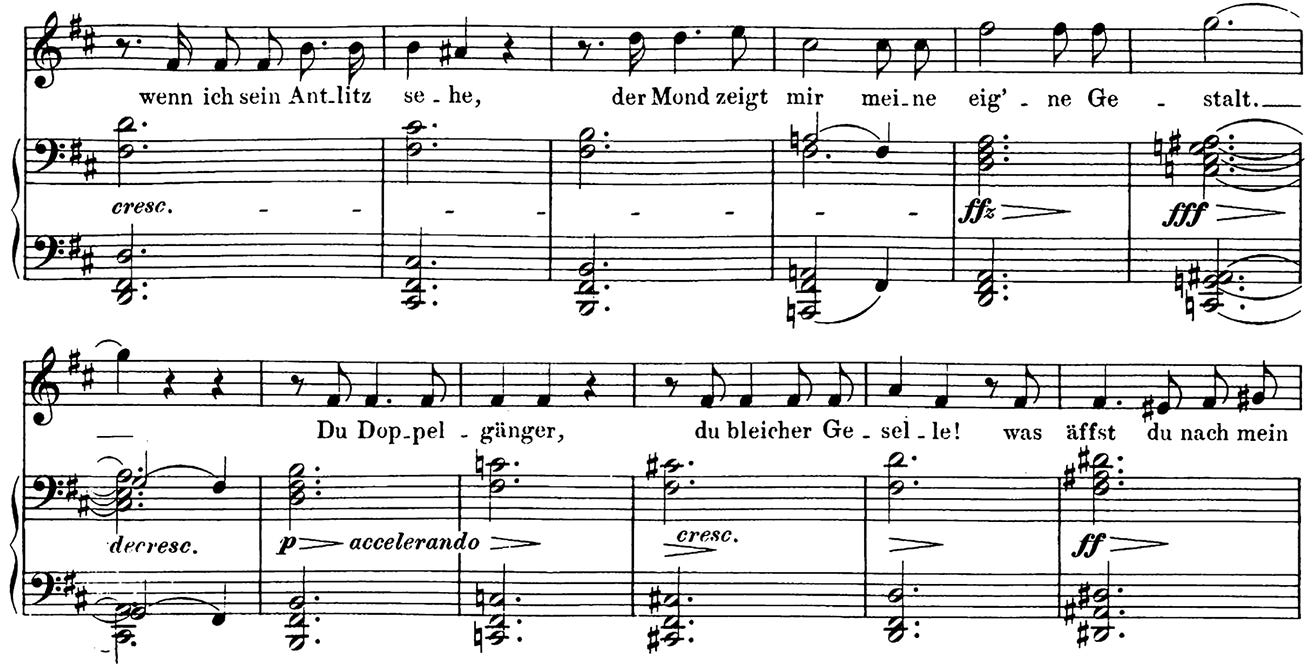
The most famous musical standoff arguably occurs in Schubert’s aptly named Der Doppelgänger from Schwanengesang, based on the poems of Heinrich Heine. Here, the confrontation is a sign that the narrator has, in fact, recognized his own death.
A man stands there also and looks to the sky,
And wrings his hands, overwhelmed by pain:
I am terrified – when I see his face,
The moon shows me my own form!
O you Doppelgänger! you pale comrade!
Why do you ape the pain of my love
Which tormented me upon this spot
So many a night, so long ago?
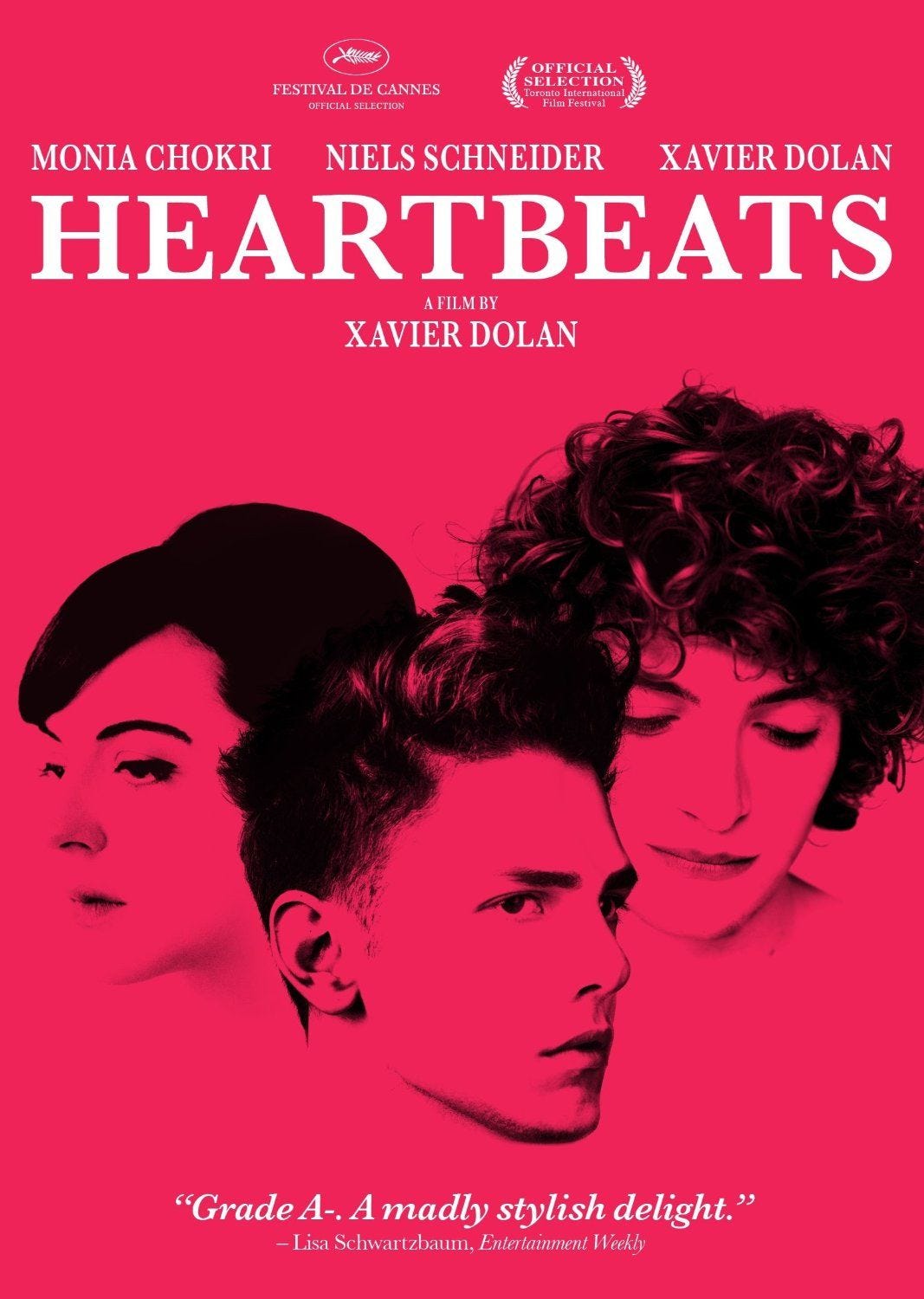
Anchit Sathi has proposed a different reading of the double; instead of portending death, the trope of the doppelganger in Paul’s Siebenkäs aims to subvert the Narcissus myth as a foundation for an aesthetics of same-sex desire. Anyone who has watched any film by the likes of Pedro Almodóvar, Gus Van Sant, or Xavier Dolan, knows this trope of gay desire well, which pretty much boils down to the ambiguity between: “do I want him” versus “do I want to be him”. (It becomes even more complex when the object of desire’s sexuality is in question, or makes them unattainable, which is often the case.) Sathi summarizes the situation regarding Jean Paul, who was very likely a homosexual, and his protagonist: “Indeed, Leibgeber – whose very name (translated literally as ‘body-giver’) is indicative of his ability to give ‘corporeality’ to Siebenkäs’ fantasies—plays a key role in allowing Siebenkäs to escape a marriage that is far from being an image of heterosexual bliss.” German Romanticism imbued this myth with a new tint of artistic creativity. Through the works of various authors like Friedrich Schelling and the Schlegel brothers, Narcissus became “a symbol of the ability of the creative genius to come to know the deepest spiritual forces within himself” rather than the poster child for a moralizing tale about vanity.
There are only three movements in Do No Harm that position Ryan and me in regular “four-hands” position from beginning to end: the second movement, “Toccata (Paresthesia)”, which, evoking the feeling of “pins and needles,” begins like a game of slapjack between us as we vie for territory around middle C, and first and final movements. But even in these outer panels, we play with our doppelgangers. This leaves only the second movement as a true four-hands piece, and even here Ryan has to leave to grab an anatomy book to prepare the piano. The key to successfully playing this movement is to be absolutely comfortable taking up space over, under, and around your partner, and this requires a degree of closeness that intensifies the distinctive intimacy of the piano duet configuration. As Philip Brett has argued in 19th-century Music, no one explored this configuration with more frequency than Schubert, who placed same-sex desire at the site of the piano duet. At the shared piano bench, two persons are in an unusual sensual proximity–”when the playing subjects are male, an enactment of the classic Western homosocial triangle in which two men engage in intimacy as each supposedly focuses on the female body, here represented by the music.” Brett also argues that the piano duet “bears heavily the mark of the inauthentic so condemned by modernism because…it is the chief repository of the literature of transcription.”
But where Do No Harm reconfigures this triangle is, I believe, in the treatment of the only thing not doubled in the videos–the piano, whose curvature (the “bentside”) reads as classically feminine. Loiacono, I might add, is also the one triggering the video. I am fairly sure she, qua composer, never consciously conceived of this and that I’ve committed the unprovoked academic act of “queering” Do No Harm, but the fact that the messiness of this dynamic is enough to fuel a sequel to Challengers (by another queer filmmaker Luca Guadagnino) is, frankly, delightful. Loiacono, I am certain, didn’t think of this angle when she conceived of a work that aestheticizes illness, but the video elements, through their activation of figures of desire, built in this secondary layer. To be clear, this is not at all a sexy work: it’s eerie, strange, and sometimes quite funny. Success for the videos, for me, came from their knotting of confusion between aspiration, vilification, idealism, self-identification, conquest, and submission. Whatever innuendos swirl about before the listeners during the hour of theater, there are, in the end, two players, two doubles, the composer at the mixing board, a disembodied voice (more on that in a future post), and, let’s not forget, the piano.